
Sobha World City Construction Status: February 2026 Update
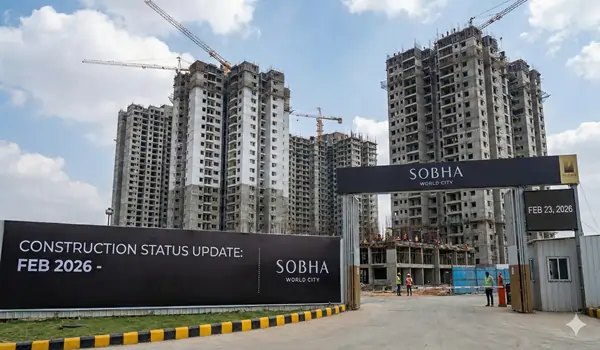
For buyers who invest in off-plan projects, the most important moment is when drawings turn into real activity on the ground. That shift has now happened at Sobha World City. The February 2026 construction update clearly shows that the project has moved from planning to active site work. The 48-acre Phase 1 land parcel in Hoskote is no longer empty. It is now filled with heavy machines, workers, storage sheds, and material piles. The transformation has started.
This early activity is not random. It marks the beginning of a disciplined 5-year construction schedule. The possession timeline remains December 2030/2031. For investors and EOI (Expression of Interest) applicants, these visible changes offer strong reassurance.
In this update, we will explain what is happening on the ground in simple terms. We will cover site clearing, earthworks, material storage, and overall progress.
Site Clearing and Boundary Marking: Preparing the 48 Acres
The first visible step in February 2026 is complete site clearing. This is more than just removing plants. It is the preparation of the land for large-scale construction. The entire 48-acre Phase 1 area has been systematically cleared. This process ensures that machines can move freely and safely.
What Has Been Completed So Far
Several key steps have already done:
- Vegetation removal: Bushes and scattered trees across the site have been removed. This allows open access for heavy equipment.
- Level surface preparation: The top layer of uneven soil has been adjusted in many parts.
- Full boundary fencing: Strong metal barricading has been installed around the perimeter.
The fencing is not only for security. It also marks the approved limits of construction as per BMRDA guidelines. Sobha is known for its "Zero Deviation" approach. This means construction stays exactly within sanctioned boundaries.
Main Entrance Alignment
Work has also started near the main access point. This entrance connects to the Hoskote–STRR junction. A sandy internal road is now visible. It is strong enough to handle large trucks and heavy-duty machines. This early access road is important. It supports the smooth daily movement of construction vehicles. Without proper access, progress would slow down.
Within the larger township vision, this clearing stage is critical. It allows engineers and survey teams to confirm the exact position of the 18 planned high-rise towers. Since some towers will rise up to G+54 floors, even small alignment errors must be avoided. This stage ensures that each tower will match the master plan and deliver the promised panoramic views.
Earthworks and Land Levelling: Building a Strong Base
Once the land is cleared, the next step is ground preparation. This is where heavy earthworks begin. Because the project includes towers up to 54 floors, the foundation must be extremely strong. High-rise buildings need deep support systems. The soil must be tested and prepared in a careful way.
Current Earthwork Activities
The following activities can be seen in February 2026:
- Deep soil excavation: Backhoes and excavators are digging in the central areas of Phase 1.
- Large soil mounds: Excavated earth is temporarily stored in organized piles.
- Ground leveling: Uneven areas are being corrected to create a uniform base level.
The purpose of leveling is simple. The land must reach a proper "plinth level." This is the base height where the building structure begins.
If leveling is not done correctly, drainage problems may occur later. Water must flow away from buildings during heavy rains. That is why careful soil redistribution is happening now.
Utility Trenching
Deep trenches are also visible across parts of the site. These trenches are not random. They are meant to house the basic infrastructure of the township.
These include:
- High-capacity sewage lines
- Water supply pipes
- Electrical conduits
Think of these as the "nervous system" of the township. They must be installed before foundations are poured. Once towers start rising, underground corrections become difficult. By completing these early steps now, Sobha ensures smoother construction later.
Material Dumping and Storage: Preparing for Full-Scale Construction
Another strong sign of progress in February 2026 is the arrival of raw materials. This stage shows that the developer is preparing for continuous construction.
The project is expected to receive its official RERA number around May 2026. Once that happens, vertical construction can begin at full speed. To avoid delays, materials are already being stocked on-site.
Temporary Storage Infrastructure
Several metal sheds and storage structures are now visible within the 48-acre area. These are temporary warehouses. They are designed to safely store primary construction materials.
Currently, these sheds are being stocked with:
- Construction trusses
- Metal framework components
- Structural materials
Having storage on-site reduces dependency on last-minute deliveries.
Sand, Gravel, and Aggregates
Dedicated dumping zones have been created for raw materials such as:
- Sand
- Gravel
- Rocky soil heaps
These materials are essential for concrete production and structural work. Sobha follows a backward integration model. This means that the company often uses its own systems for concrete and pre-cast components.
Organized dumping ensures:
- Faster mixing cycles
- Controlled material usage
- Reduced wastage
Machinery Depot
The site now includes a machinery zone. This area houses:
- Backhoes
- Soil compactors
- Forklifts
These machines are ready for continuous operation. Their presence shows that the project is not waiting for approvals to begin preparation. The groundwork is already in motion.
STRR Advantage and Logistics Support
One important advantage of this project is its location near the Satellite Town Ring Road (STRR). So, because of this connectivity, trucks carrying materials do not need to pass through central Bengaluru traffic.
They can bypass congested city routes.
This leads to:
- Faster delivery cycles
- Reduced transport delays
- Better cost control
Efficient logistics directly protect the 4.5-year vertical growth schedule, and keep in mind that every single day saved during material movement matters.
Now, in large projects, delays often happen due to supply chain gaps. The current February 2026 update shows that Sobha is preparing in advance to avoid risks like this.
Why This Early Progress Matters to Buyers
The pre-launch stage can feel uncertain for many off-plan buyers. There are brochures, master plans, and promises. Yet, the visible construction builds confidence. The February 2026 activity at Sobha World City proves that invisible planning work has already translated into visible execution.
RERA Preparation
Around May 2026, the official RERA number is anticipated. In order to guarantee fast progress after legal approvals are finished, Sobha completes site clearing, levelling, and material dumping beforehand.
Following approval, there won't be a waiting time. Work can go on uninterrupted.
Strong Structural Foundation
High-rise towers reaching nearly 175 meters demand deep and stable foundations. By focusing now on soil testing, excavation, and trenching, the developer is securing long-term structural safety.
Foundation strength determines tower durability. Spending time on ground preparation reduces the risks later.
Timeline Protection
Every truckload of soil moved in February 2026 saves time in the long run.
Early groundwork supports:
- Faster basement construction
- Timely foundation pouring
- Smooth vertical growth
This protects the December 2030/2031 possession timeline.
A Disciplined 5-Year Roadmap
The activity seen in February 2026 marks the formal beginning of a structured 5-year execution plan. Large-scale projects require strict coordination. Clearing, levelling, utility installation, and material stocking are all part of Phase 1 groundwork.
This disciplined approach ensures that when tower construction begins, there are no surprises.
The goal is clear:
- Begin vertical construction post-RERA
- Maintain steady growth
- Complete within the promised timeline
Ground Reality vs. Blueprint
Until recently, Sobha World City was mostly a master plan on paper. Now it is a live construction site. Heavy machines are active. Soil mounds are visible. Storage sheds are built. Boundary fencing defines the land.
The difference between vision and execution is now visible to anyone visiting the site. For early-bird investors and EOI applicants, this is strong validation. The asset they committed to is taking shape physically.
Conclusion: A Growing Landmark in East Bengaluru
The February 2026 construction update tells a clear story, i.e. momentum has started. The 48-acre Phase 1 land parcel is no longer in planning mode. It is in action mode. From full-scale site clearing to organized material dumping, every visible step confirms serious intent. This project aims to become one of Bengaluru's tallest residential townships. That journey has officially begun.
Therefore, for buyers who have already submitted their EOI, the current progress builds confidence. Along with that, for the ones still evaluating, this stage offers better clarity. The groundwork completed today protects the 2030/2031 delivery promise. It also reflects Sobha's reputation for disciplined execution.
As East Bengaluru continues to grow, this 48-acre development in Hoskote is steadily moving from blueprint to skyline reality. The pre-launch window will not remain open forever, as, with machines already on-site and earthworks underway, Sobha World City is no longer just a plan for the future. It is a project in motion.

 24/7 Support
 Free Site Visit
 Unmatched Price